
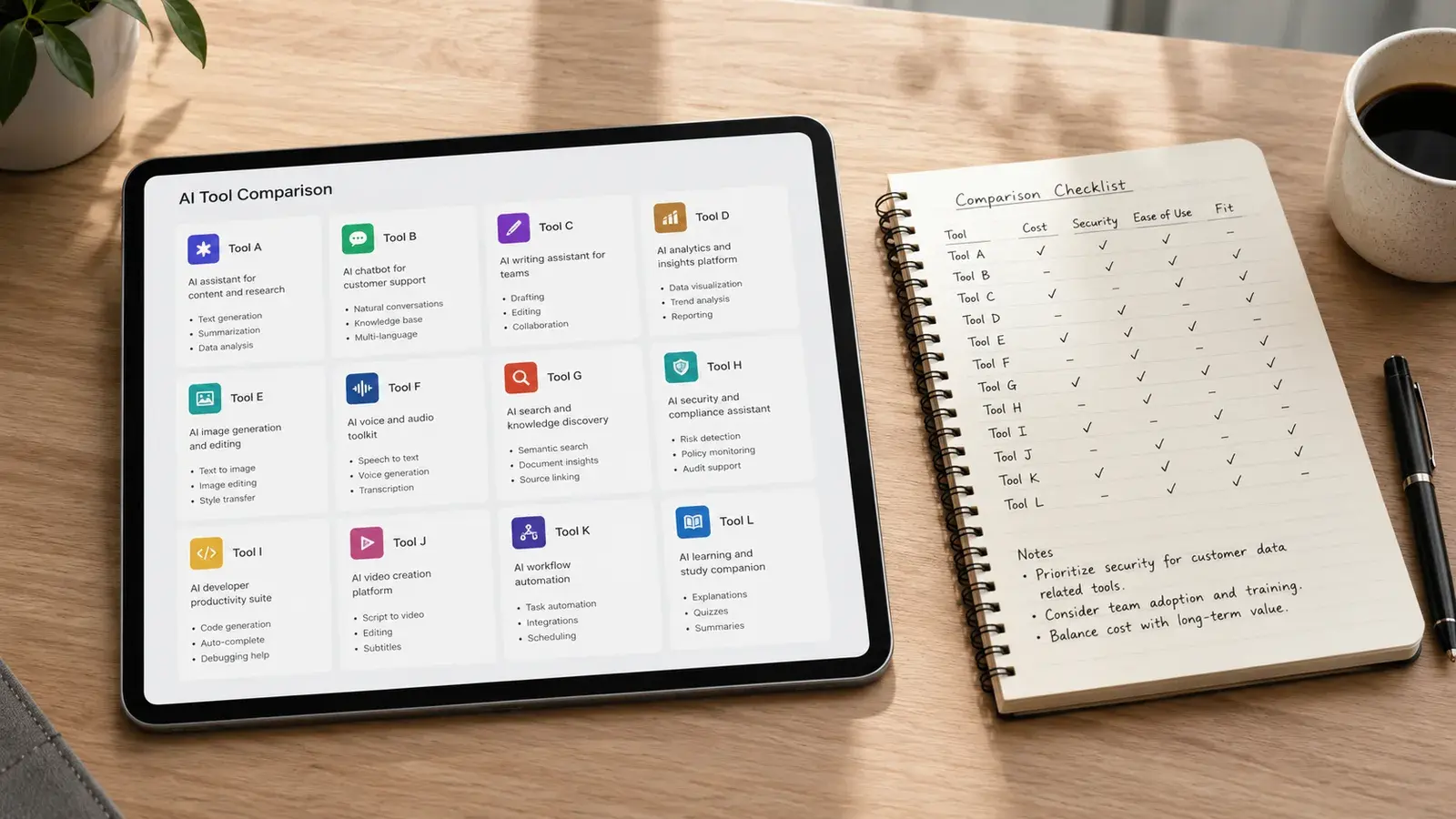
To choose the right AI tools for your business, start with the job to be done, not the tool. Run every option through four questions: what exact task will it do, what data will it touch, does the vendor offer a data processing agreement, and what is your exit plan if it fails. Anything that cannot answer all four is not ready for your business.
Knowing how to choose AI tools for your business is less about finding the single best product and more about having a filter you can apply to any of them. The options multiply every week, and most guides answer the wrong question by handing you a list of tools rather than a way to judge them. There is a legal edge to this too: the moment a tool touches customer or staff information, GDPR obligations attach, and under EU AI Act Article 4 you are already responsible for making sure your people understand the tools they use. A simple four-question filter handles both the practical and the legal side without turning the decision into a research project.
Do you actually know what data each tool on your shortlist would touch, and where it would go? An AI Readiness Assessment maps that before you commit to anything.
Why does choosing the right AI tools feel so overwhelming?
The overwhelm is a criteria problem, not a tool problem. When you have no fixed way to compare options, every new tool looks equally plausible, so the list never gets shorter and the decision never gets made.
Most owners meet AI as a stream of names. A newsletter praises one tool, a peer swears by another, a vendor emails about a third, and each sounds convincing on its own terms because there is nothing to measure them against. The result is one of two failure modes. Either months pass and nothing gets adopted, or three overlapping subscriptions get bought in a burst of enthusiasm and quietly abandoned within weeks because none of them fit an actual workflow. Neither is a technology failure. Both come from choosing before there was any standard to choose against.
The fix is to stop evaluating tools and start evaluating them against a fixed set of questions. Once the questions are the same every time, the field narrows quickly, and the tools that survive are the ones that fit your business rather than the ones with the loudest marketing. If you want the wider picture of readiness that sits underneath any tool decision, our guide to whether your business is actually ready to adopt AI is the place to start, and a full step-by-step method for introducing AI covers the journey around this one decision.
In summary
If your shortlist never gets shorter, the missing piece is a fixed set of criteria to judge the options against. Build the filter first and the list narrows itself.
Question one: what exact task do you want the tool to do?
Name the single job before you look at any tool. A tool chosen for "AI" in the abstract has no test for success, while a tool chosen to draft first replies to booking enquiries can be judged inside a week.
This is the question that saves the most wasted money, because a vague goal cannot be met or measured. "Use AI to be more efficient" gives you nothing to check against, so any tool can seem to qualify and none can be judged a failure. Replace it with something you could describe to a colleague in one sentence: sort the shared inbox by urgency, draft replies to routine supplier queries, pull the week's figures into a plain summary, flag invoices that do not match what you expected. Each of those has a visible outcome you can inspect in days rather than months.
Deciding which task comes first is its own step, and there is a method for it rather than a guess. Our guide to which tasks are actually worth automating sets out a same-day task audit you can run before you shop for anything. Once the task is named, the tool question becomes narrow and answerable: does this specific tool do this specific job well, yes or no.
In summary
Pick the task before the tool. If you cannot say in one sentence what the tool is for and check whether it did that job within a week, you are not ready to choose a tool yet.
Question two: what data will the tool touch?
Map the data the task needs before you enable the tool, because that is what decides your obligations. If the task touches personal data such as customer names, email addresses, or staff records, data protection law applies no matter how small the business is.
Work out exactly what the tool would see to do its job. An assistant that summarises public web pages touches nothing sensitive. An assistant that reads your inbox to draft replies touches every name, address, and private detail in those messages. The two are not the same decision, even if the tool is identical, because the second one puts personal data into a third party's system. The principle to hold onto is data minimisation: give the tool only what the task genuinely requires, not blanket access to everything because it is easier to set up that way.
This question also flushes out the quiet risk of staff pasting client information into a free consumer tool that was never meant to hold it. If there is no sanctioned tool for a job people need done, someone will improvise one, and the improvised choice rarely has any of the protections the next two questions ask about.
In summary
The same tool can be a safe choice or a data protection problem depending only on what you let it see. Decide what data the task actually needs before you switch anything on, and give the tool nothing more.
Question three: does the vendor give you a data processing agreement?
If the tool will handle personal data, the vendor must be willing to sign a data processing agreement, and no agreement means the tool is not ready for that job. Under GDPR Article 28, a business that uses a supplier to process personal data on its behalf must have a legally binding contract in place before the processing starts.
You are the controller and the AI vendor is the processor, and the data processing agreement is the contract that binds them to handle your data properly. The Irish Data Protection Commission is clear that this contract is mandatory, not a nicety, and it sets out what the agreement must contain: the vendor may only process the data on your documented instructions, must keep it confidential and secure, must let you know about and control any sub-processors it hands the data to, and must help you meet your own obligations if a customer asks what data you hold or if there is a breach. A vendor that will not provide this, or hides it behind an enterprise plan you are not on, is telling you the tool is not built for business data.
Two practical checks sit alongside the agreement. Ask where the data is actually processed and stored, because a "GDPR compliant" badge on a marketing page is not the same as a commitment about where your data goes; our guide to where your data is actually processed covers that in full. And check whether the free or consumer tier you are trialling uses your inputs to train the vendor's own models, because the answer is often different on a paid business plan than on the free one.
A data processing agreement satisfies Article 28. It does not by itself cover every GDPR obligation a tool might trigger: you still need a lawful basis for the processing, and a valid transfer safeguard if the vendor processes data outside the EEA. Treat the agreement as where due diligence starts, not where it ends.
In summary
A data processing agreement is the difference between a tool built for business and a tool that happens to be free. If the vendor will not sign one, the answer is no, whatever the features look like.
Question four: what is your exit plan if the tool stops working?
Before you commit, know how you would get your data out and delete it if the tool fails, the price jumps, or the vendor disappears. A tool you cannot leave cleanly is a liability even when it works, because it removes your ability to change your mind.
The exit plan is the question owners skip most often and regret most sharply. A tool becomes woven into a daily routine, the business grows to depend on it, and only when something goes wrong does anyone ask how to leave. Ask it at the start instead. Can you export your data in a usable format, or is it locked inside the vendor's system? If you cancel, does your information get deleted or does it linger indefinitely? The same data processing agreement from question three helps here, because it must require the vendor to delete or return your personal data at the end of the arrangement on your instruction, which turns a vague hope into a contractual right. A tool that traps your data has quietly taken a decision away from you, and that cost rarely shows up until you want to switch.
In summary
Decide how you leave before you arrive. If you cannot export your data and have it deleted on request, the tool owns you rather than the other way around, and you will only notice when it is expensive to fix.
What about your team, once you have chosen?
Choosing the tool is not the last step; your staff need to understand what it does and where it can go wrong. Since 2 February 2025, EU AI Act Article 4 has required organisations to make sure the people using AI systems have a sufficient level of AI literacy for the tools and the context they work in.
This is lighter than it sounds and does not mean a formal course or a certificate. The Commission's own guidance says there is no certificate requirement and that keeping an internal record of the guidance you have given is enough. What it does mean is that you cannot hand people a powerful tool and say nothing about its limits. The Commission gives a concrete example: a business whose staff use a tool like ChatGPT to write marketing copy or translate text should make sure those staff understand specific risks such as the tool inventing facts that look convincing. A short, plain briefing tied to the actual tool you chose and the actual task it does satisfies this far better than a generic AI policy nobody reads. If you want the detail on who needs training and to what depth, our guide to what Article 4 actually requires covers it in full.
In summary
Picking the tool is not the finish line. A short, plain briefing on what the chosen tool does well and where it fails is both good practice and a live legal expectation, and it costs you an hour, not a training budget.
If you are staring at a shortlist and still cannot say which tool earns its place, that is worth a conversation. An AI Use-Case Discovery Workshop works through your real tasks and matches the tools that actually fit them, and a first chat costs nothing.