
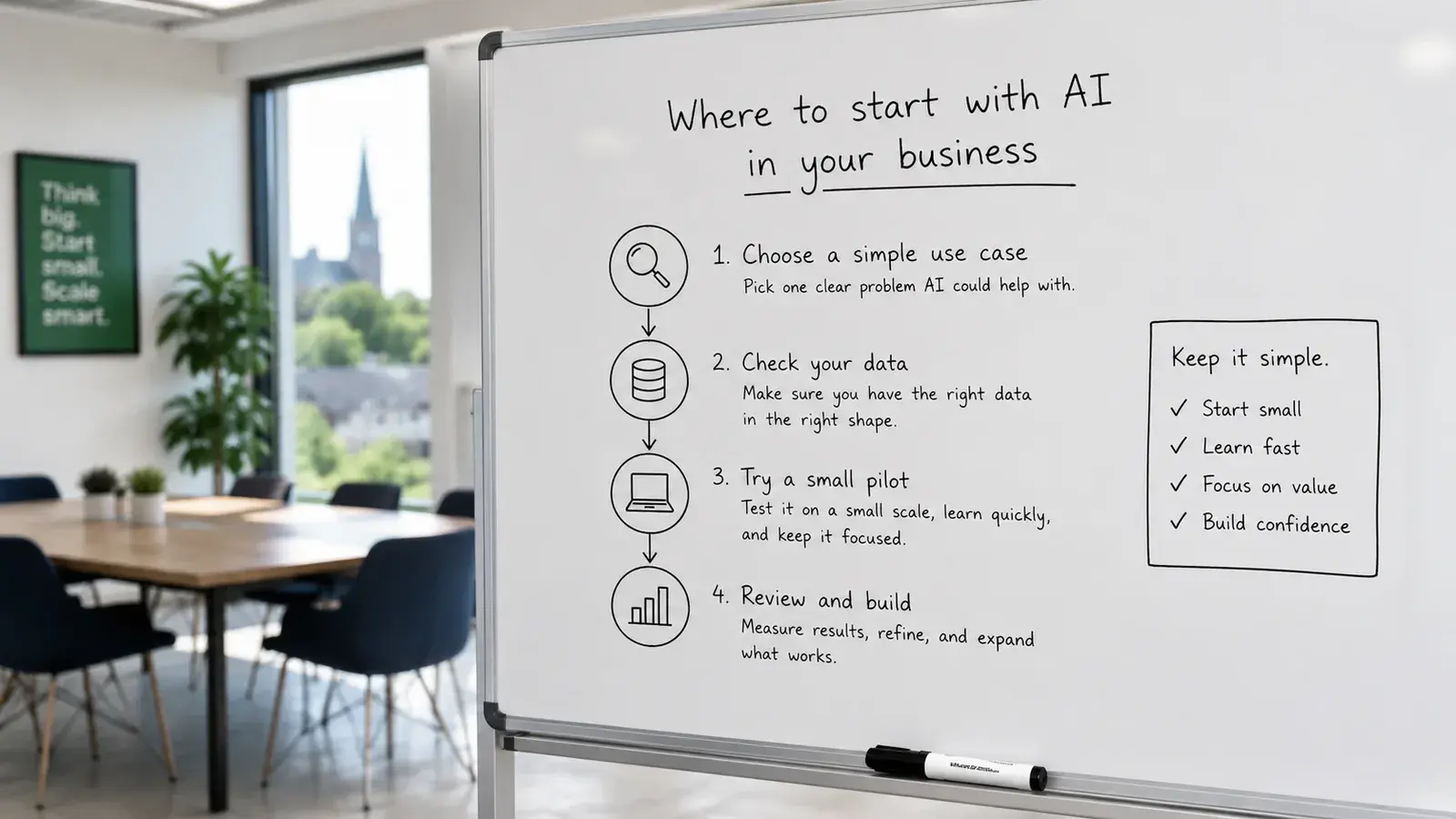
Your business is ready to adopt AI when four things are in place: a specific problem worth solving, data you can actually reach and trust, one named person who will own the result, and a team that will use the tool. If any one of the four is missing, that gap is the work to do first, not the AI.
An AI readiness assessment is a straightforward check of whether the conditions for a successful AI project are in place before you spend a euro on tools. You do not need to pay for one to begin. Most of it you can do yourself, honestly, in about ten minutes, by looking at four things any owner already knows the answer to. Readiness has little to do with owning the latest technology or setting aside a large budget. It comes down to whether a real problem, your data, a named owner, and a willing team are lined up behind the decision. Even the legal baseline points the same way: since 2 February 2025, Article 4 of the EU AI Act has required businesses that provide or deploy AI systems to take reasonable measures ensuring staff who operate AI on their behalf have a sufficient, role appropriate level of AI literacy. National authorities began actively enforcing that duty on 2 August 2026, though the underlying obligation has applied since 2025. [1] An AI Readiness Assessment is the fastest way to find out where your business actually stands before you commit budget to any tool.
What does it mean for your business to be ready for AI?
Being ready for AI means the conditions that make a project succeed are already in place: a real problem, data you can use, a named owner, and a team that will adopt the tool. Readiness is a set of concrete conditions inside your business, and whether they are present predicts success far more reliably than which product you buy.
The most common reason Irish businesses are not ready has nothing to do with money or technology. Research from the Economic and Social Research Institute, funded by the Department of Enterprise, Tourism and Employment, found that the factor most strongly holding Irish SMEs back from adopting AI or planning to invest in it is a limited understanding of what AI can realistically do and how well it works, ahead of cost or skills. [2] So the real blocker is usually clarity. Most businesses have not pinned down what they would actually use a tool for yet, and that understanding is where readiness starts.
This article gives you a self-check you can run yourself. For the formal, scored version of the same check across six dimensions, with a maturity baseline and a prioritised action plan, see what a formal readiness assessment covers.
In summary
Readiness lives in four conditions inside your business: a real problem, data you trust, a named owner, and a willing team. The honest ten-minute check below tells you whether to move now or fix something first.
Sign one: is there a specific problem worth solving?
The first sign that your business is ready for AI is that you can name a specific problem it would solve, what that problem costs you now, and what a good result would look like. If you cannot finish the sentence "we want to fix this, it costs us that, and we will know it worked when this happens," then the immediate priority is clarity about your own operations, not shopping for a tool.
This matters because the businesses getting value from AI are not pointing it at something abstract. They are pointing it at ordinary, repetitive work. In Ireland, the most common purposes for AI are business administrative processes and marketing or sales, followed by accounting and financial management. [3] None of that is glamorous, and that is exactly the point. A clearly named, unglamorous problem is a far better starting point than an exciting idea with no measurable edge.
If you want a structured way to compare candidate problems, there is a full step-by-step method for introducing AI that scores each option before you commit. It is also worth being honest about which tasks are actually worth automating, because plenty of jobs that look like AI problems are really process or training problems in disguise.
In summary
If you cannot state the problem, its cost, and what success looks like in one sentence, that clarity is the first job, and it costs nothing but honest attention.
Sign two: can you reach and trust your own data?
The second sign is that the data an AI tool would need is something you can actually get to, in a reasonably consistent format, and would trust enough to put in front of a client. AI runs on your data, so if that data is scattered across systems, inconsistently recorded, or missing the details the task depends on, the tool inherits every one of those problems.
"We have lots of data" is not the test. Reachable and trustworthy are the tests. A quick self-check: could you pull the relevant records together this week without a special project, are they recorded the same way each time, and would you stand over them if a decision rested on them? When businesses look closely, the usual discovery is that the data exists but lives in three different places and nobody has checked it in a while. That is a fixable problem, but it is a problem to fix before a tool arrives, not after.
The scale of this matters because data work is the workhorse of business AI. Data mining is the single most common form of AI use among Irish enterprises, which means the most widely used capability depends entirely on data you can reach and rely on. [3]
In summary
Before any tool, ask whether you could gather the data this week, whether it is recorded consistently, and whether you would trust it in a client report. If not, tidying the data is the real first project.
Signs three and four: who owns the result, and will your team use it?
The third and fourth signs are that one named person owns the outcome of the AI project, and that the team who will use the tool are both willing and able to. A system with no clear owner tends to drift: nobody reviews its outputs, nobody catches when it goes wrong, and it is quietly abandoned within months. Naming an owner before you start is what keeps an AI tool accountable to the business rather than floating loose inside it. For why ownership and clear lines of responsibility matter so much before you scale anything, see why an owner and clear governance matter before you scale.
The people question is just as decisive. Adoption fails on people far more often than on technology. A team that was briefed on a tool but never given hands-on time to test it, question it, and see where it fails will not trust it, and a tool the team does not trust does not get used. There is also a legal floor here worth knowing: Article 4 of the EU AI Act requires businesses that provide or deploy AI systems to take reasonable measures ensuring staff who operate or use AI on your behalf have a sufficient, role appropriate level of AI literacy, an obligation that has applied since 2 February 2025. [1] That obligation and plain good sense point in the same direction, which is that your team needs real familiarity, not a one-off briefing. For the wider picture of what the EU AI Act asks of Irish businesses, the pillar guide covers it in full.
None of this requires a large budget. It requires a decision about ownership and a modest investment of the team's time, both of which are within reach of any business that is serious about getting a result.
In summary
Name one person accountable for the outcome before you start, and give the team real hands-on time with the tool. Ownership and familiarity decide whether AI gets used or quietly shelved.
What if the honest answer is "not yet"?
If the honest answer is that your business is not ready yet, that is useful information, because it names the exact next move rather than leaving you guessing. A "not yet" is not a failure and it is not a reason to give up on AI. It is a short to-do list.
Each missing signal maps to a specific task. No clear problem means the next job is defining one precisely, in terms of cost and outcome. Data you cannot reach or trust means a tidy-up comes before any tool. No owner means a decision about who is accountable. A team that is not on board means giving them hands-on time and a genuine say in how the tool is used. Work through whichever signals are missing, and you convert a vague sense of being behind into a handful of concrete steps. Then start small, with one bounded use case, rather than trying to transform everything at once. This is also where readiness becomes momentum: the same Irish research shows that raising a business's genuine understanding of what AI can do for it is associated with the investment that follows. [2]
The point of this check is not to talk you out of AI. It is to make sure that when you do move, you move from a position where the effort pays off rather than one where it quietly stalls.
In summary
A "not yet" is a to-do list, not a verdict. Fix the missing signal, start with one bounded use case, and let a real result build the confidence for the next step.
The AI Readiness Assessment is built to answer exactly this, scored around your business rather than a generic checklist, and a conversation about where you stand costs nothing.