
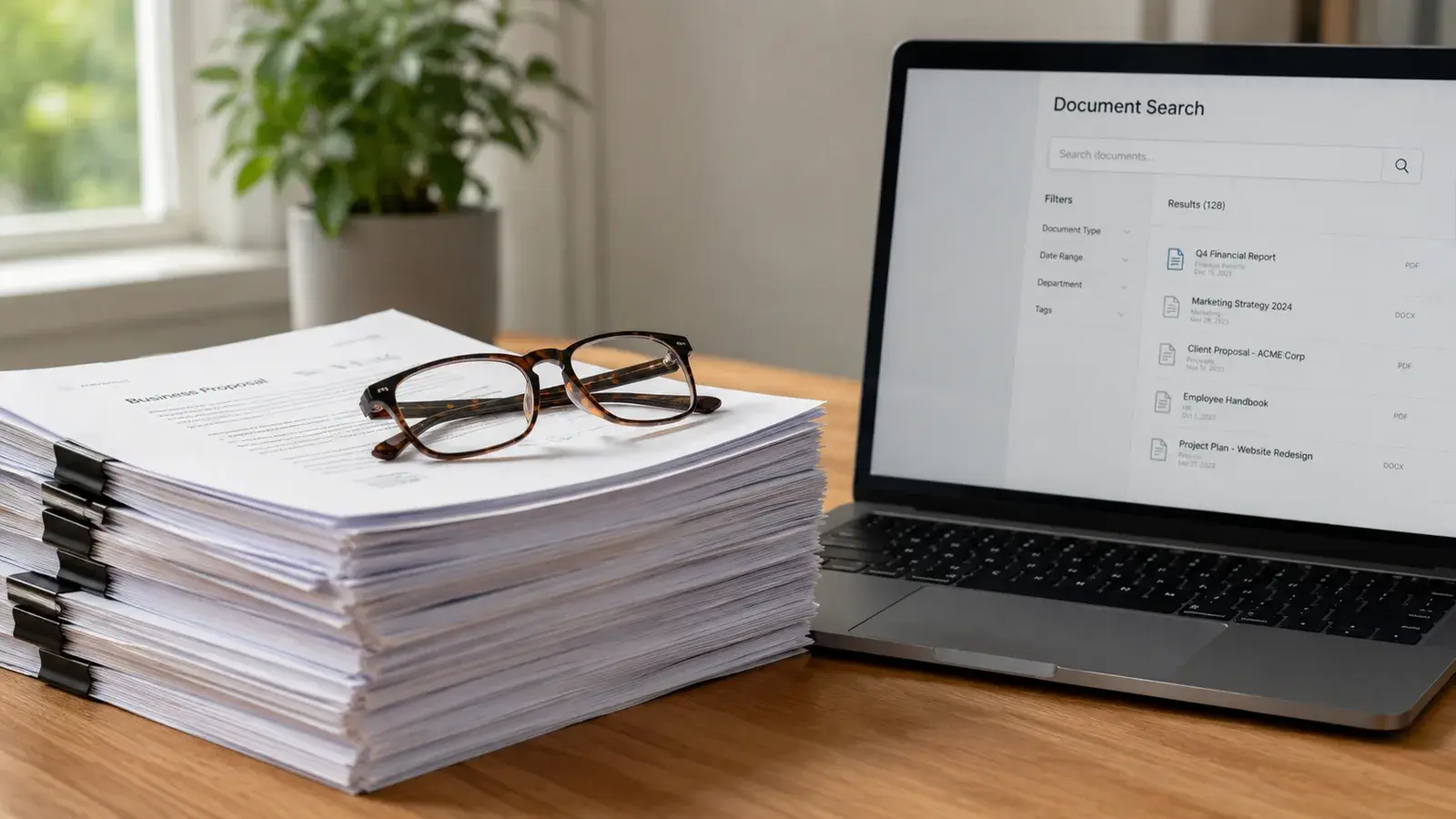
Data readiness for AI means your business information is findable, accurate, consistently structured, and lawful to use, so that an AI tool can produce reliable results from it. The condition of that data, more than the tool you choose, decides whether an AI project delivers or disappoints.
Data readiness for AI is the practical work of getting your business information into a state an AI tool can actually use, and it is the step most Irish SMEs skip on the way to a disappointing result. Before a tool can draft your emails, answer questions from your records, or spot patterns in your sales, it needs data it can find, trust, and lawfully process. That last word carries weight. Under GDPR Article 5, personal data must be accurate and kept up to date, and it can only be processed for the purpose it was originally collected for or a purpose compatible with that, which shapes what you can feed an AI system in the first place. [1] Checking your own data readiness costs nothing and needs no technical skill. It comes down to five questions you can answer about your business this week.
Do you actually know where your customer and operational data lives, and whether you are allowed to feed it to an AI tool? An AI Readiness Assessment maps exactly that before you spend a euro on software.
What does data readiness for AI actually mean?
That definition is not abstract. An AI system only ever works with the data you actually give it, so records that are hard to locate, out of date, or inconsistently recorded will produce unreliable output, however capable the underlying model is.
This is a live concern in Ireland, because data is already the ground most business AI runs on. In 2025, using AI for data mining was the single most common form of AI use among Irish businesses, ahead of language generation and workflow automation, and it was the most common use across small, medium and large firms alike. [2] Pulling value from your own records is the mainstream use case, and it depends entirely on those records being usable.
There is a recognised standard for what usable data looks like, even though it does not apply as law to most small businesses. The EU AI Act, in Article 10, sets a binding requirement for providers of high-risk AI systems: their data must be relevant, sufficiently representative, and to the best extent possible free of errors and complete for its intended purpose. [3] That obligation falls on providers of high-risk systems, a narrow category unlikely to include the everyday tools most SMEs use, such as drafting assistants or CRM-based analytics. For everyone else Article 10 carries no legal force, but the description still works as a useful benchmark for any business. It is the shape your data should be in before you rely on it.
Data readiness is one part of the wider groundwork covered in how to introduce AI into your business, and it sits alongside a broader readiness self-check that also looks at people and ownership. This article stays on the data itself: five checks to run before you choose a tool.
In summary
An AI tool can only be as good as the data behind it. Before you judge any tool, judge whether your own records are findable, current, consistent, and yours to use.
Can you find your data, or is it scattered across systems?
The first check is whether you can actually locate the information an AI tool would need, or whether it is spread across systems that do not talk to each other. In most small businesses the answer is that it is scattered: contact details in a CRM, order history in an accounts package, notes in email threads, a product list in one person's spreadsheet, and files across a shared drive and a few laptops.
An AI tool can only draw on data it can reach. If the information for the job you have in mind lives in five places, gathering it into one accessible source is the first task, and it is often the one that takes the most effort. The EU AI Act's Article 10(2)(e) frames this same idea for high-risk systems as assessing the availability, quantity and suitability of the data sets that are needed before building anything. [3] The small business version is simpler. Pick the one job you want AI to help with, list every place the data for it currently sits, and note who controls each one. That map tells you how far you are from having the raw material in usable reach.
In summary
Start with one job, then list every place its data lives and who controls each source. If the answer is five different systems, consolidating them is your real first step, ahead of any tool.
Is your data accurate and up to date?
Data that is easy to find can still be wrong, and an AI tool has no way of knowing the difference. Duplicate customer records, contacts who left three years ago, prices that changed last quarter, and half-completed fields all feed straight through into the output. A summary built on stale records reads as confidently as one built on current ones, so inaccurate data becomes especially risky once an AI tool is presenting it with a straight face.
For any data that identifies a person, accuracy is also a legal expectation. GDPR Article 5 requires personal data to be accurate and, where necessary, kept up to date, and requires reasonable steps to erase or rectify inaccurate data without delay. [1] The EU AI Act points the same way, asking that data used by high-risk systems be, to the best extent possible, free of errors. [3] You do not need to audit every record. Take a sample of the data you plan to use, check how much of it is current and complete, and you will quickly see whether a clean-up comes before the tool.
In summary
Sample a slice of the data you plan to use and check how much is current and complete. Stale records produce confident, wrong answers, so a clean-up often earns more than any upgrade in tool.
Is your data structured and consistent enough for AI to use?
An AI tool works best when data is organised in a consistent, predictable way, with the same fields recorded in the same format every time. Real business data is rarely that tidy. Dates written five different ways, customer notes typed as free text with no structure, categories that mean different things to different staff, and key fields left blank all make it harder for a tool to work reliably from the records.
Getting data into shape is ordinary preparation work, and the EU AI Act names the same operations for high-risk systems: annotation, labelling, cleaning, updating, enrichment and aggregation. [3] For a small business the practical version is to settle on one consistent format for the fields that matter, make sure the important ones are actually filled in, and tidy the free text into something more structured where a tool will need to read it. This is unglamorous work, and it is usually the difference between a pilot that produces something useful and one that quietly stalls.
In summary
Consistency beats volume. One format for the fields that matter, the important ones filled in, and structured rather than free-text notes will do more for your results than a larger pile of messy records.
Are you allowed to use this data for AI?
Holding the data is not the same as being allowed to use it this way. Under the GDPR, personal data can only be used for the purpose it was collected for or a compatible purpose, a principle called purpose limitation, and it must be limited to what is necessary for that purpose. [1] Customer contact details gathered to fulfil orders were not necessarily gathered to train or feed an AI tool. GDPR Article 6(4) sets out the factors for assessing whether a new use is compatible with the original purpose, and where it is not, a fresh legal basis, such as consent, is needed before that data can be used for AI.
The Data Protection Commission has published guidance for organisations using AI and large language models. It sets out that AI processing of personal data should have a clear legal basis, apply data minimisation by using only the data that is genuinely needed, and keep that data of sufficient quality, while leaving individuals able to exercise their rights over it. [4] This guidance explains how the underlying GDPR principles apply to AI, rather than creating obligations beyond GDPR itself. The practical move is to go through your intended data sources and, for each one, ask what it was originally collected for and whether feeding it to an AI tool is compatible with that. Where personal or sensitive data is involved and the answer is unclear, that is the point to take advice before proceeding.
In summary
For each data source you plan to use, ask what it was collected for and whether AI use fits that purpose. Data gathered for one reason cannot always be repurposed to feed a tool.
Where does your data go once you feed it to a tool?
The moment you paste business information into an AI tool, that data leaves your control and is processed by the vendor, so the final check is knowing where it goes and on what terms. Whether that vendor acts as your processor or as an independent controller depends on the specific arrangement. Many free or consumer tier tools that reuse your inputs to train their own models act as separate controllers rather than processors, which changes what compliance requires, so check the vendor's terms before assuming the standard processor relationship applies. In either case, the Data Protection Commission's guidance is that a business should understand and be able to explain how personal data is protected once another organisation is involved in processing it. [4]
In practice that means two things before any data goes near a tool. First, confirm whether the vendor is your processor or a controller in its own right. Where it is a processor, GDPR Article 28 requires a written data processing agreement, covered in full when choosing an AI tool. [5] Where a vendor is acting as a controller, a data processing agreement is not the right instrument, and you need a separate legal basis for sharing the data with it. Second, get clarity on where your data is processed and stored. Free and consumer tiers of popular tools may use your inputs to improve their own models and may store data outside the EU. Transfers outside the EU are not automatically unlawful under GDPR, but they require a valid transfer mechanism such as an adequacy decision or standard contractual clauses, so check how the vendor handles this before you use a tool with real business data. Confirm all of this early, because the exposure that comes from skipping this check surfaces later, when it is harder and more costly to unwind.
In summary
Before real business data goes near an AI tool, confirm whether you need a data processing agreement and know where the data is processed. Consumer tiers often train on your inputs, so check the terms first.
You are aiming for data that is good enough for one specific job. A flawless, company-wide database is far more than a first AI project needs, and waiting for one is a common way for businesses to stall. The five checks above tell you whether your data clears that lower, more useful bar. Getting it there is the groundwork an AI Readiness Assessment is built to map, alongside the other dimensions of readiness, and it is work you can begin before choosing any tool. If you are unsure where your data stands, get in touch and we can work out the right next step together.