
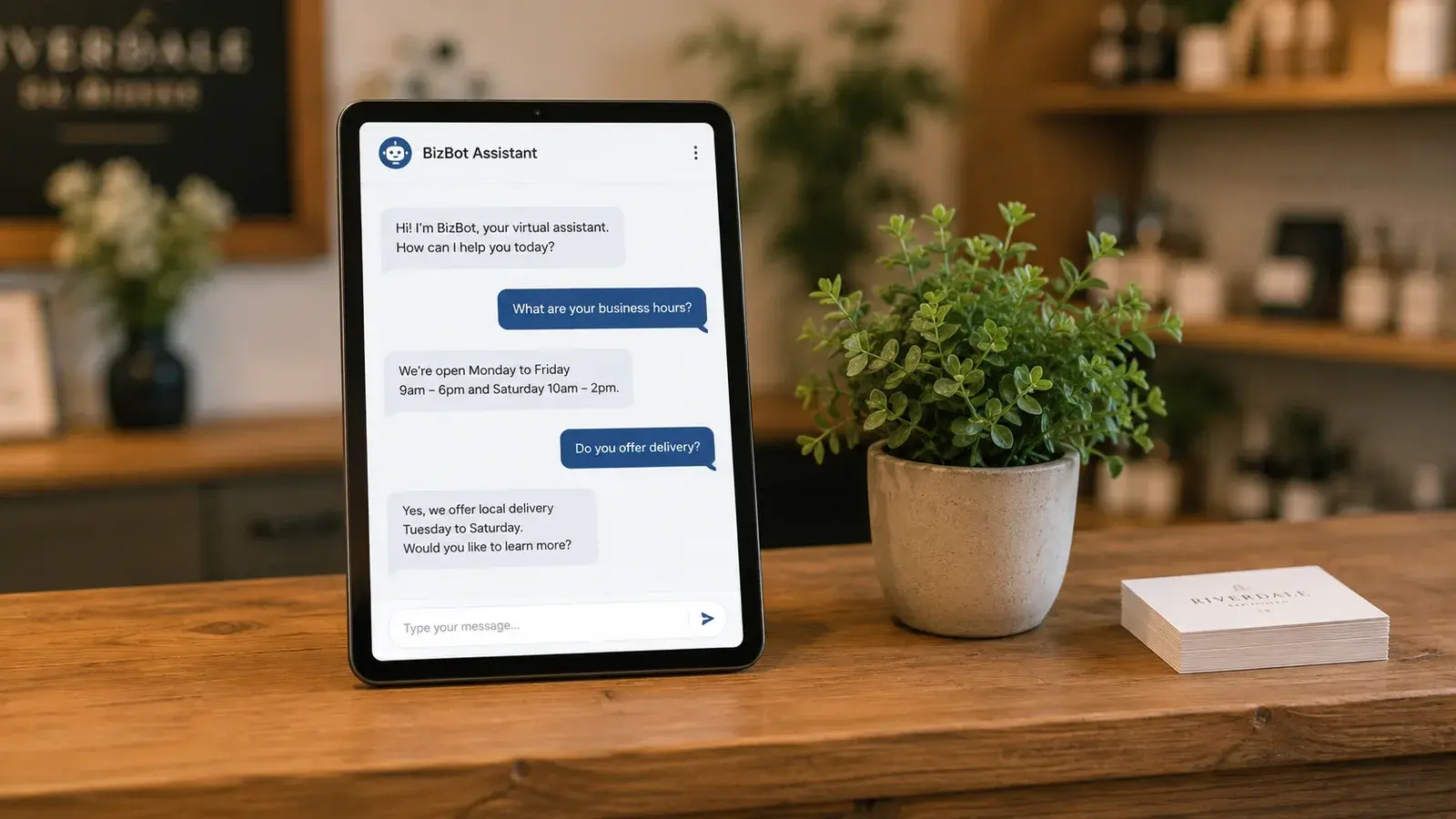
An AI agent for business is software that can plan a task, take action across your systems such as email, CRM, or calendar, and check the result, without a person approving each step. That is what separates it from a tool like ChatGPT, which only produces a draft for you to review.
AI agents for business are the natural next step after tools like ChatGPT and Microsoft Copilot, but they work differently in a way that matters. Under EU AI Act Article 50, any AI system that interacts directly with a person, such as a customer-facing agent, must make clear that the person is talking to AI, a rule that applies in Ireland from 2 August 2026. If you are wondering whether "AI agent" is a genuine capability worth looking at or just this year's marketing term, this guide explains what agents actually do, where the real risk sits, and how to pick a safe first use case.
If you want to know whether your business already has AI agents running quietly inside the tools you use, that is exactly what an AI Readiness Assessment is built to surface.
What can AI agents actually do for a small business right now?
Right now, the AI agents that work reliably for small businesses are narrow and single-purpose, not general-purpose assistants that run your whole operation. They are built to handle one repeatable workflow well.
The most common practical examples in an Irish SME context: an agent that reads an inbound enquiry email, checks the sender against your CRM, and drafts a reply for review, or sends it directly if you have decided that is low-risk enough; an agent that monitors a shared inbox or support queue and sorts incoming messages by urgency so nothing sits unread; an agent that reconciles invoices against a list of expected payments and flags anything that does not match; an agent built into a scheduling tool that books, reschedules, and sends reminders without anyone touching the calendar.
None of these require a large IT team to set up. Most arrive already built into tools you may already be paying for. Microsoft Copilot Studio, Zapier's AI steps, and the AI features inside many CRM and helpdesk platforms now include agent capability that can be switched on inside an existing subscription, which is exactly why an inventory of what you already have matters before you go looking for something new. If your business runs on Microsoft 365, check the Copilot agent settings in Teams, SharePoint, and Outlook specifically, since these are sometimes active by default rather than switched on deliberately.
In summary
The AI agents that earn their place in a small business today handle one repeatable job well: drafting a reply, sorting a queue, reconciling an invoice. Many are already sitting inside the tools you pay for, waiting to be switched on.
How many Irish businesses are already using AI agents?
Just 17.2% of small Irish enterprises used AI technology of any kind in 2025, compared with 57.7% of large enterprises, so if you have not adopted an AI agent yet, you are well within the norm.
That gap is worth sitting with. Across all Irish enterprises, 20.2% reported using some form of AI technology in 2025, more than double the 8% recorded two years earlier,[4] so adoption is accelerating quickly even if small businesses are still catching up. This mirrors the adoption gap between small and large Irish businesses that shows up across AI use generally, not just agents specifically.
The adoption figure on its own understates the real gap, though. A recent ESRI study of Irish SMEs, drawing on the Central Bank's Credit Demand Survey, found that even among firms already using AI, most have not formalised it: 55.5% describe their AI use as ad-hoc rather than formal, rising to 67.2% among firms still at the testing stage, and falling to 39.0% only once usage becomes genuinely high intensity.[8] That distinction matters more for an agent than for a chatbot. An unstructured, ad-hoc approach to a tool a person reviews before anything happens is a minor risk. The same unstructured approach applied to an agent that acts without a person reviewing each step is a much bigger one.
In summary
Most Irish SMEs have not deployed an AI agent yet, so you are in the majority. Your advantage is that you get to choose one narrow, well-judged use case while the pattern is still forming.
What actually goes wrong when businesses pick their first AI agent use case?
The mistake is rarely the technology. It is almost always the choice of task. Once an agent is deployed, the operational risks (access sprawl, cascading errors, shadow agents, prompt injection) are real, and our AI agent governance guide sets out the minimum controls for those. This article's job is different: helping you avoid a bad choice before any of that becomes relevant.
The quiet escalation trap is the most common. A business starts an agent on something narrow, drafting replies for a person to send, and it works well. Three weeks later, someone decides it should send them directly, then connects it to the CRM since it is already reading those enquiries anyway. Each step feels reasonable on its own. Nobody re-evaluates the risk profile of the combined result, because no single decision looked like a big one.
Picking the impressive option over the reversible one is the second. Faced with a shortlist, businesses often gravitate toward the use case that sounds most innovative to describe to a board or a customer, AI powered lead scoring, say, over the one that is actually safest to start with, like flagging invoice mismatches for a person to check. The more impressive option is usually also the one that is harder to undo and touches more sensitive data.
Choosing a use case you cannot actually verify is the third. "Improve customer response quality" is not a first use case. It is a hope. If you cannot check, within days, whether the agent did the job correctly, you have no way of catching a quiet failure before it compounds. A good first use case has a fast, visible feedback loop: something you or a colleague can check against reality daily or weekly, not a vague outcome you would only notice months later if it went wrong.
Trusting a vendor's default scope without checking it is the fourth. Many safe-sounding agent features arrive already switched on inside tools you pay for, and their actual default permissions are rarely as narrow as the marketing copy implies. Before treating any built-in agent feature as your safe starting point, check what it can actually read and write, not what the product page says it is for.
If an agent does send an incorrect communication or modify a customer record it should not have touched, begin your GDPR breach assessment immediately. Under GDPR Article 33, the 72-hour notification clock to your supervisory authority runs from when you become aware, but only where the breach is likely to result in a risk to the rights and freedoms of natural persons. Low-risk incidents involving personal data do not automatically trigger supervisory notification, though all breaches must be documented internally. Do not wait until your internal investigation is concluded before starting the assessment.
In summary
The businesses that get burned by their first AI agent rarely chose bad technology. They chose a task that quietly grew in scope, sounded more impressive than it was reversible, or could not be checked against reality fast enough to catch a mistake.
Which use case should you start with?
Score each candidate task you are considering out of 3 on four factors, and add them up.
| Factor | 1 point | 2 points | 3 points |
|---|---|---|---|
| Data sensitivity | Touches customer, financial, or personal data | Touches internal only data | No sensitive data involved |
| Reversibility | Hard to undo, affects a specific person | Takes real effort to undo | Trivial to undo, low visibility if wrong |
| Human review | Agent acts with no review | Agent drafts, human reviews before send | Agent only flags, human does everything |
| Task frequency | Rare, hard to learn from | Weekly | Daily, fast feedback loop |
A task scoring 9 to 12 is a safe starting point. A task scoring below 6 needs a human approval gate before you touch it, regardless of how appealing the time saving looks. Score your three or four candidate tasks side by side rather than picking the one that sounds most impressive.
In summary
Score each candidate task on data sensitivity, reversibility, human review, and frequency, then let the number pick your first use case. The winner is usually the quiet one.
Does the EU AI Act apply to the AI agent you're considering?
Most AI agents used in a typical Irish SME today, such as drafting replies or triaging a queue, fall outside the EU AI Act's high-risk category, but that depends entirely on what the agent decides, not on the fact that it is an agent.
Article 6 of the EU AI Act sets out when a system counts as high-risk. Systems listed in Annex III, which covers areas like employment, credit, and biometrics, are treated as high-risk unless they meet a specific carve-out: performing a narrow procedural task, improving the result of a human activity that has already been completed, or preparing input for a human decision without replacing it. A typical drafting, triage, or invoice-reconciliation agent does not fall within any Annex III category at all for most SMEs, which means the high-risk classification simply does not apply without needing to reach the carve-out question. For agents that do touch an Annex III category, Article 6(3) may exclude them from high-risk classification, though the European Commission's draft guidance published in May 2026 interprets these exceptions more strictly than many assumed: an agent that categorises or scores individuals, rather than simply routing messages, may not qualify regardless of how narrow its other tasks appear.[6] The one carve-out that never applies is profiling: an agent that profiles individual people, such as one used to screen job applicants or assess creditworthiness, is always treated as high-risk under the Act, regardless of how narrow its task looks.
There is a separate, more immediate obligation if your agent talks to customers directly, such as a website chatbot or phone agent. Under Article 50(1), the provider, meaning whoever built or commissioned the system, must design it so the person knows they are talking to AI, at or before the first interaction. If you have bought a chatbot or phone agent from a vendor rather than building one yourself, you are the deployer, not the provider, and your first practical step is confirming your vendor has already built that disclosure in, rather than assuming you need to build your own. Two further deployer obligations exist under Article 50. If your business deploys an emotion recognition or biometric categorisation system, Article 50(3) requires you to inform individuals exposed to it that the system is in operation. If your organisation uses AI to generate deepfake image, audio or video content, or to generate text published to inform the public on matters of public interest, Article 50(4) requires you to disclose that the content was artificially generated or manipulated, subject to certain exceptions for human editorial review. You should not suppress or override any disclosure your vendor has already implemented. This applies from 2 August 2026, was not changed by the AI Omnibus (formally adopted by the EU Parliament on 16 June 2026 and by the Council on 29 June 2026, awaiting Official Journal publication), and carries fines of up to €15 million or 3% of global annual turnover for the preceding financial year, whichever is higher, under Article 99(4) of the Act. For SMEs and start-ups, Article 99(6) applies the lower of those two figures, not the higher. The European Commission's draft guidelines on Article 50, published 8 May 2026 ahead of that date, set out the provider/deployer distinction in more detail.[5] Separately, the high-risk deployer obligations under Article 26 for stand-alone Annex III systems are confirmed to move to 2 December 2027 under the AI Omnibus, which was formally adopted by both institutions in June 2026 and is awaiting Official Journal publication, expected before 2 August 2026. The December 2027 date is in formally adopted law, not merely a planning assumption.
In summary
What your agent decides is what sets its legal duties. An agent that drafts replies and triages a queue sits in one regulatory bracket. One that screens job applicants or assesses credit sits in another, and only the second carries a duty to disclose it exists.
How do you choose a safe first AI agent use case?
The safest first AI agent use case is internal, narrow, and low-stakes: something that touches routine admin rather than customers, money, or personal data, and where a mistake is easy to catch and cheap to fix.
A good starting checklist: pick one workflow, not several at once. Keep the agent's access limited to exactly what that workflow needs, nothing broader, the specific fields or records the task requires rather than your full CRM or inbox. Before connecting the agent to email, CRM, calendar, or any other system holding customer, employee, or supplier data, confirm your platform vendor has a signed Data Processing Agreement in place, ask where that data is processed, and check whether the vendor uses it to train its own models; the Irish DPC's guidance on AI and data protection sets out the baseline expectation here.[7] Decide up front whether the agent's output needs a human to approve it before anything goes out, and for a first use case, default to yes. If the task involves ranking, scoring, or categorising specific people rather than routine admin, it is not a safe first use case: that is profiling, and the Act always treats it as high-risk regardless of how narrow the task looks. Write down what the agent is allowed to do somewhere your team can see it, so it does not become a shadow agent nobody else knows about. Once you have run that first use case for a few weeks and it has behaved the way you expected, you have a genuine basis for deciding whether to expand it or add a second one.
If you are not sure where to start, or whether your business already has agent-like features quietly switched on inside tools you already pay for, a structured AI readiness assessment is designed to answer exactly that question before you commit to anything new.
In summary
Give your first agent one low-stakes job and run it for a few weeks. Once it behaves the way you expected, you have earned the basis to expand it or add a second.
If you are ready to map where AI agents could safely help your business first, an AI Readiness Assessment gives you that starting point, mapped to the tools and workflows you already run.